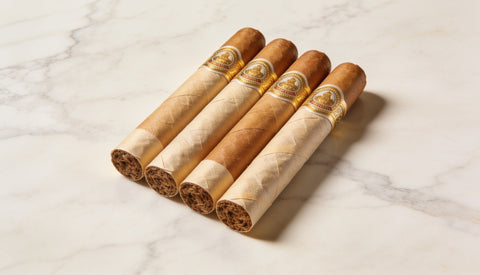


How to Age Cigars (3-Step Guide)
I'm Gerard from Mardo Cigars, and this week we're talking about starting a cigar collection and how to age cigars the right way. Freshly made cigars often carry a lingering hint of ammonia, and they need proper storage and time for the aging process to work its magic. Here is my simple three-step method to condition your cigars for prime smoking. Learn how to age cigars this way and your collection only gets better with time.

Step 1: Season Your Humidor and Check the Seal
Before you age cigars, your humidor has to hold steady humidity, and that starts with seasoning it. Every humidor is a case-by-case job. Size and shape matter, and those odd triangle humidors with compartments and drawers season differently. The bigger the box, the more time it needs. The easy route is a Boveda 85% pack, which is made specifically to season a humidor. For the full walkthrough, see our guide on cigar humidor best practices.
Now the seal, and here you get what you pay for. If a giant humidor is beautiful but only costs $200, I'd question it. A lot of cheap humidors are not true solid wood; the inside is a thin Spanish Cedar veneer, sometimes less than an eighth of an inch. I'd rather have true Spanish Cedar inserts, and for that you are looking at anywhere from $500 to $600 up to $3,000. Good makers include Vigilant cabinet humidors, Prometheus, Diamond Crown, and Elie Bleu. Yes, they cost real money, but a quality humidor is a piece of furniture that lasts 20 to 30 years and can be passed on.
The flashlight seal testDrop a lit flashlight inside the humidor, close the lid, and step into a dark room. If you see light shining through, especially behind the hinges, the seal is weak. A tight seal makes a huge difference in seasoning and in holding humidity over the life of the humidor.
Step 2: Cellophane On or Off?
This one gets a lot of mixed messages. People say aging with the cellophane off gives you too much cedar, but that is not always true. I have aged cigars cellophane-off in an acrylic humidor with no real cedar transfer, using only tiny strips of cedar from cigar boxes to keep the cigars from touching each other. I did that mainly for Cuban cigars, which do not come with cellophane at all.
You can age Cuban cigars right in the box, and that works well. I personally do not, because I lose visual on the bottom layer and I want to keep an eye out for beetles, especially on expensive sticks. For cigars that do come with cellophane, I keep it on. It protects the cigar, keeps cedar scent out in a cedar-lined humidor, and stops the cigars from touching. As a bonus, the cellophane slowly shifts from clear to a dark tint, which is a great visual sign that the cigar has aged a long time.
SituationWhat to do Cigar has cellophaneKeep it on; it protects and shows aging as it darkens Cuban / no cellophaneAge in the box, or use small cedar strips to separate Expensive sticksKeep them visible so you can watch for beetles
Step 3: How Long Should You Age Cigars?
This is the big question when you learn how to age cigars, and the answer depends on the cigar. Some cigars are not worth aging more than three months because it will not make a difference. Think of an inexpensive, mild, diluted cigar with barely any ligero and a lot of seco filler. A couple of months just softens it on the palate by shedding the last of the ammonia.
For premium cigars, my honest opinion is not to age more than three to five years. I want to keep the oils in the wrapper, binder, and filler. I have tasted the same cigar aged three years and seven years, and with a lot of Opus X I do not think extra time makes it better. I smoked a seven-year Opus X recently and could not tell it apart from a two-year one. Age much longer and you start losing those oils, no matter how well humidified your space is.
Cigar typeHow long to age Cheap, mild, diluted2 to 3 months (just to shed ammonia) Most premium cigars3 to 5 years at most Beyond ~5 yearsRisk losing the oils; often no gain
"Air is the biggest enemy of anything we own. It breaks down everything. So age your cigars long enough to shine, but not so long that you lose what makes them great."
One tip I wish I had followed: keep a logbook. Track the brand, size, and how long you aged each cigar, and note whether it was worth it. Over time that record becomes your best guide. For a clever way to speed things along, check out our trick in how to age your cigars.
Watch: How to Age Cigars
See all three steps straight from the episode on Mondays with Mardo:
Final Thoughts
That is how to age cigars in three simple steps: season a well-sealed humidor, make the right call on cellophane, and give each cigar the right amount of time. Season carefully, buy quality when you can, keep cheap cigars only a few months, and rest your premium sticks three to five years. Do that and your collection will smoke beautifully for years. For steady humidity while they rest, our guide on how to use Boveda packs has you covered.
Mardo Cigars sells premium tobacco products intended for adults 21 and older. Please enjoy responsibly.